EU GPSR for Pet Products: What Private Label Brands Must Prepare
The European Union's General Product Safety Regulation (GPSR), coming into effect on December 13, 2024, will directly impact private label pet product brands selling in the region. Understanding what is required and who is responsible is essential to avoid compliance risks.
Thank you for reading this post, don't forget to subscribe!The EU GPSR mandates that private label brands ensure their products meet stringent safety, labeling, and traceability requirements before entering the market.[^1] Brands must clarify their legal obligations, collaborate with EU-based economic operators, and work with manufacturers fluent in documentation and testing standards.

While factories like ours can support your goals with materials, testing, and traceability documentation, brands and their EU partners carry the core responsibility for compliance. Let’s break down what we know so far and what private label brands need to prepare.
What is the EU GPSR, and why does it matter for pet products?
For pet products, the GPSR broadens safety responsibilities to cover online sales and provides clearer obligations around risk analysis, labeling, and traceability for all supply chain players.

Starting December 2024, the GPSR will apply to products like pet crates, carriers, beds, and travel accessories, ensuring they meet updated safety standards.[^3] Its extended reach to online platforms will mean even private label products shipped directly to EU customers must comply.
Notably, the GPSR also introduces the role of a "responsible economic operator" — someone in the EU, like an importer or authorized representative, who ensures compliance and documentation are in place. This is crucial for private-label brands outsourcing manufacturing overseas.
Why pet products face scrutiny
Pet products, especially those interacting closely with animals and owners, pose unique risks.[^4] Faulty crates can collapse, harmful materials can cause rashes, and badly designed carriers can fail during travel. Under the GPSR, such risks must be assessed, reported, and transparent to consumers.[^5] Brands targeting the EU must build these safety assurances into their production and marketing processes.
Who is responsible for GPSR compliance?
Regulations like this distribute obligations. Private label brands, EU-based economic operators, and manufacturing partners all have distinct roles.

Brand responsibilities
- Conduct market research to understand legal and safety expectations for your product category.
- Draft clear product specifications, including GPSR-compliant labeling and safety instructions.
- Stay organized with testing reports, risk assessments, and traceability data.
While you can delegate certain tasks (like testing or logistics), the ultimate liability remains with the brand. Ignorance is not an excuse in regulatory matters.
The role of EU economic operators
Under the GPSR, you must appoint a responsible economic operator within the EU to:
- Verify technical documentation and risk assessments.
- House product dossiers for any compliance checks or audits.
- Handle consumer safety complaints and coordinate necessary recall actions.
Common operators include:
- Importers (if you’re headquartered outside the EU)
- Authorized representatives
- Fulfillment service providers
Manufacturer/factory support
While manufacturers like us are not legally responsible for compliance, we provide critical support by ensuring product specifications align with safety standards. Factories are expected to:
- Source safe, certified materials.
- Provide batch traceability and testing reports upon request.
- Maintain transparent communication to harmonize production with EU expectations.
It’s important to note that factories cannot decide legal strategies or act as compliance lawyers for your business. For instance, while we can perform tensile strength tests on a pet playpen, only you — in collaboration with your EU representative — can decide whether the test standards are adequate for your legal needs.
What changes will GPSR bring to product labeling and online listings?
Improper labeling has been a weak point in product safety compliance.[^8] Under the GPSR, these rules will get stricter, particularly for online sales.
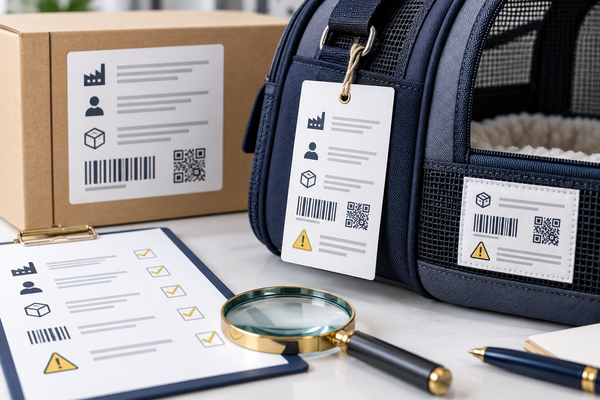
Every physical product and online listing must include complete, transparent information on safety and economic operators.
Key labeling and listing elements to prepare
- Safety warnings: Visible and easy-to-read notices regarding the proper use and potential risks of the product.
- Economic operator details: Information about the EU-based party responsible for compliance (name, address, and contact).
- Traceability information: Batch or serial numbers that connect products to production data, making recalls more efficient.
- Material disclosures: Compliant declarations for materials that interact with pets, particularly for plastics, fabrics, and zippers.
Online retailers will also face more scrutiny.[^9] All safety instructions must be available digitally, ensuring the end consumer understands how to use the product safely before checkout.
How can factories help private label brands meet these requirements?
Manufacturers contribute by ensuring safe material selection, producing to strict specifications, and organizing traceability and testing data in support of EU requirements.
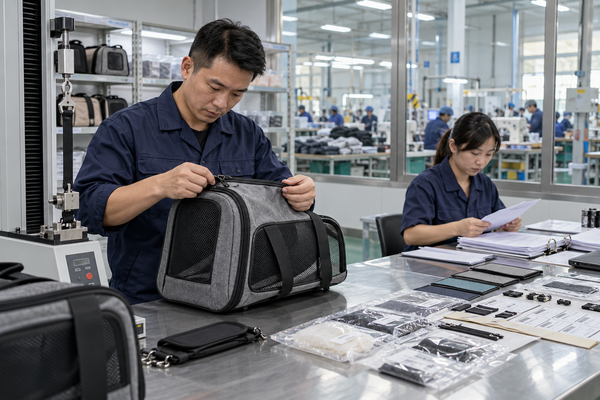
Examples of factory contributions:
- Conducting pull, break, or wear testing for structural elements like zippers or mesh.
- Providing customized packaging that includes required safety labeling.
- Offering modular sourcing advice (e.g., which plastics meet European safety certifications).
- Sharing production batch logs for traceability audits.
We encourage our clients to collaborate early in the production timeline. For example, specifying preferred certification standards upfront (e.g., OEKO-TEX for pet bedding) allows us to streamline material sourcing decisions.
Remember: quality control at the manufacturing level builds the foundation of compliance, but it’s not sufficient on its own without active coordination between the brand and EU economic operators.
Frequently Asked Questions
What happens if your product doesn’t comply with the EU GPSR?
Non-compliant products may be banned from entering the EU.[^11] If sold already, your products may face recalls, fines, or legal challenges — damaging both revenue and brand reputation.
Do online brands need to follow the GPSR?
Yes. Even if your private label sells directly to EU customers online, it must meet GPSR requirements, including traceability and listing safety details in digital stores.
Can the factory act as the EU economic operator?
No. Factories primarily handle production. Only legal entities within the EU can act as economic operators, including importers, representatives, or fulfillment centers.
Conclusion
Preparing for EU GPSR compliance is critical for private label pet product brands targeting Europe. The new regulation underscores the importance of risk assessments, traceability, and labeling, especially for online sales. While manufacturers support the process with testing and production data, the ultimate responsibility lies with the brand and its EU partners.
Ensure your compliance strategy is ready well ahead of December 2024. For reliable manufacturing support with safety-conscious materials and thorough documentation, contact us to discuss your pet product plans today.
[^1]: "EU Consumer Goods General Product Safety Regulation ...", https://www.trade.gov/market-intelligence/eu-consumer-goods-general-product-safety-regulation-gpsr. The European Commission's official documentation on the General Product Safety Regulation outlines the updated requirements for safety, labeling, and traceability for consumer products entering the EU market. Evidence role: general_support; source type: government. Supports: The GPSR includes safety, labeling, and traceability requirements for consumer goods.. [^2]: "EU Consumer Goods General Product Safety Regulation ...", https://www.trade.gov/market-intelligence/eu-consumer-goods-general-product-safety-regulation-gpsr. The European Commission's transition plan for the GPSR confirms its role as a replacement for the GPSD and highlights the enhanced safety measures introduced. Evidence role: historical_context; source type: government. Supports: The GPSR replaces the GPSD and introduces stricter safety standards.. [^3]: "EU Consumer Goods General Product Safety Regulation ...", https://www.trade.gov/market-intelligence/eu-consumer-goods-general-product-safety-regulation-gpsr. The European Commission's guidelines on the GPSR specify its applicability to consumer goods, including pet-related products such as crates and carriers. Evidence role: general_support; source type: government. Supports: The GPSR applies to pet products like crates, carriers, and beds.. [^4]: "Potentially Dangerous Items for Your Pet", https://www.fda.gov/animal-veterinary/animal-health-literacy/potentially-dangerous-items-your-pet. Research studies on pet product safety highlight risks such as material toxicity and structural failures that can harm pets and their owners. Evidence role: mechanism; source type: research. Supports: Pet products can pose risks due to their interaction with animals and owners.. Scope note: Specific examples of risks may vary depending on the product type and usage. [^5]: "EU Consumer Goods General Product Safety Regulation ...", https://www.trade.gov/market-intelligence/eu-consumer-goods-general-product-safety-regulation-gpsr. The European Commission's guidelines on the GPSR specify the requirements for risk assessment, reporting, and consumer transparency for products sold in the EU. Evidence role: mechanism; source type: government. Supports: The GPSR mandates risk assessment, reporting, and transparency for consumer products.. [^6]: "EU Consumer Goods General Product Safety Regulation ...", https://www.trade.gov/market-intelligence/eu-consumer-goods-general-product-safety-regulation-gpsr. The European Commission's official documentation on the GPSR outlines the compliance responsibilities of private label brands, including market research and collaboration with EU representatives. Evidence role: general_support; source type: government. Supports: Private label brands are responsible for compliance under the GPSR.. [^7]: "EU Consumer Goods General Product Safety Regulation ...", https://www.trade.gov/market-intelligence/eu-consumer-goods-general-product-safety-regulation-gpsr. The European Commission's enforcement guidelines for the GPSR detail potential penalties for non-compliance, including import refusals and fines. Evidence role: case_reference; source type: government. Supports: The GPSR specifies penalties for non-compliance, including import refusals and fines.. [^8]: "History of Nutrition Labeling - NCBI - NIH", https://www.ncbi.nlm.nih.gov/books/NBK209859/. Studies on product safety compliance in the EU have identified labeling as a frequent area of non-compliance, leading to consumer risks and regulatory actions. Evidence role: historical_context; source type: research. Supports: Improper labeling has been a common issue in product safety compliance.. Scope note: The historical context may not apply uniformly across all product categories. [^9]: "European Union", https://en.wikipedia.org/wiki/European_Union. The European Commission's guidelines on the GPSR specify compliance requirements for online retailers, including digital safety information and traceability. Evidence role: general_support; source type: government. Supports: The GPSR includes provisions for increased scrutiny of online retailers.. [^10]: "EU Consumer Goods General Product Safety Regulation ...", https://www.trade.gov/market-intelligence/eu-consumer-goods-general-product-safety-regulation-gpsr. The European Commission's documentation on the GPSR clarifies the roles of manufacturers, emphasizing their support in material safety and traceability. Evidence role: definition; source type: government. Supports: Factories are not legally responsible for compliance but contribute to the supply chain under the GPSR.. [^11]: "EU Consumer Goods General Product Safety Regulation ...", https://www.trade.gov/market-intelligence/eu-consumer-goods-general-product-safety-regulation-gpsr. The European Commission's enforcement guidelines for the GPSR detail scenarios where non-compliant products may be banned from entering the EU market. Evidence role: case_reference; source type: government. Supports: Non-compliant products may face bans under the GPSR..


Questions or Comments?
Share your thoughts below. For OEM/ODM inquiries, contact our factory team directly by email or WhatsApp.