
How Packaging Size Can Make or Break a Pet Product’s Profit Margin
For pet product brands, packaging size often feels like an afterthought — but it shouldn’t be. In fact, packaging size can make or break a pet product’s profit margin[^1]. Ignoring it during the design stage can lead to missed cost-saving opportunities, higher logistics expenses, and even negative customer reviews.
Thank you for reading this post, don't forget to subscribe!Packaging that minimizes wasted space, ensures durability, and aligns with your product's end use can significantly improve profit margins. This involves smart decisions upfront, from structural design to material selection.
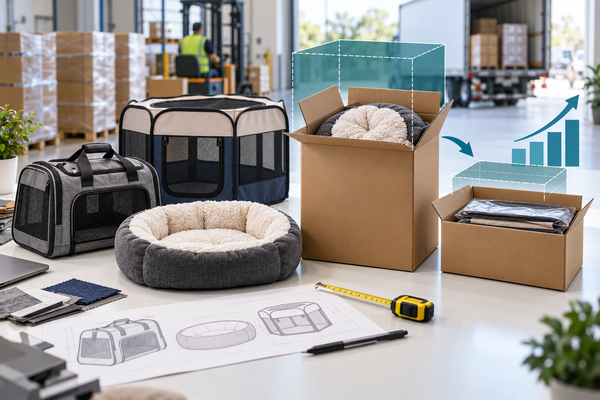
But what does the right packaging size entail? Explore how choices in product design phases — like folding frameworks, vacuum compressions, and retail-ready displays — influence your bottom line.
Why Is Packaging Size Crucial for Pet Product Profit Margins?
Packaging optimization starts with understanding its impact. Let’s unpack the problem further.
Poorly optimized packaging drives up operational costs
Oversized, irregular, or poorly structured packaging leads to wasted space in storage and shipping, which drives up costs.[^2] This doesn’t just hurt margins but also impacts your pricing competitiveness. Overlapping logistics inefficiency compounds for wholesalers and e-commerce sellers alike.
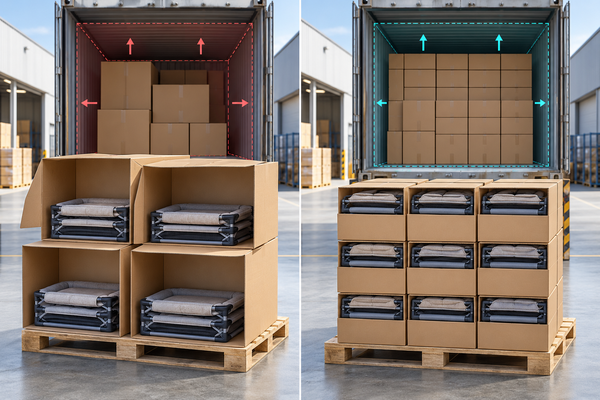
The solution lies in creating packaging dimensions that balance compactness with usability and structural stability. However, compact packaging presents other challenges, like how consumers interact with the product — which we’ll address below.
How Do Removable and Fixed Frameworks Impact Packaging Size?
Removable structures seem like a clear advantage, but what are the trade-offs?
Removable frameworks reduce folded packaging size but add complexity
Products with removable frameworks can significantly reduce transit and storage volume, making shipping more economical.[^3] However, they often require instructions or assembly efforts, which can affect consumer experience.
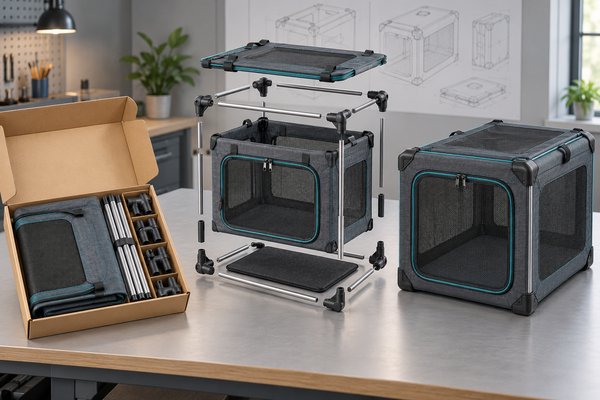
For example, folding dog crates with detachable parts are ideal for decreased dimensions. Yet these might prompt "hard-to-assemble" complaints — leading to returns or negative reviews.
For fixed structures, the question becomes whether higher logistics costs outweigh the simplicity and quicker setup appeal. Let’s weigh the difference in a table comparison:
| Packaging Scenario | Folded/Removable Framework | Fixed Framework |
|---|---|---|
| Packaging Size | Smaller, flexible shipping options | Larger, higher freight costs |
| Consumer Assembly | Requires effort, possible errors | Simple, "ready out of the box" |
| Logistics Complexity | More efficient pallet arrangement | Wasted space inside cartons |
| **Appeal for Retail/E-comm | Convenient shipment savings | Immediate usability appeal |
Does Folding Too Small Make Consumer Use Hard?
Small packaging sounds like a win — but could compact designs alienate users?
Reduced packaging can increase consumer frustration during reassembly[^4]
Products folded too small might be difficult for buyers to reassemble once unpackaged. For instance, travel pet bags compressed into tight zippered cases may confuse users, converting a shipping advantage into poor usability.
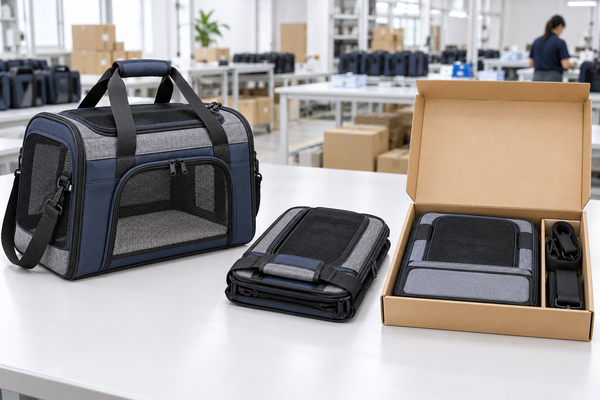
To combat this, you’ll need:
- Clear user instructions.[^5]
- Trial-tested structural integrity under compression forces[^6] (e.g., foam components).
- Thoughtful zippers, Velcro tabs, or stretchy materials for restoring the product’s shape smoothly.
OEM design teams should put themselves in consumers’ shoes. Small testing tweaks can prevent negative reviews and costly retours down the line.
Are Folded and Vacuum-Compressed Products a Good Option?
Compression can drastically cut transport volume — but is this always viable?
Compression is cost-saving but risks durability concerns
Vacuum-compressed foam beds or soft fabrics help save space but risk permanently deforming materials or losing elasticity.[^7] Consider premium pet beds — clients will notice if the cushion never fully recovers after unpacking.
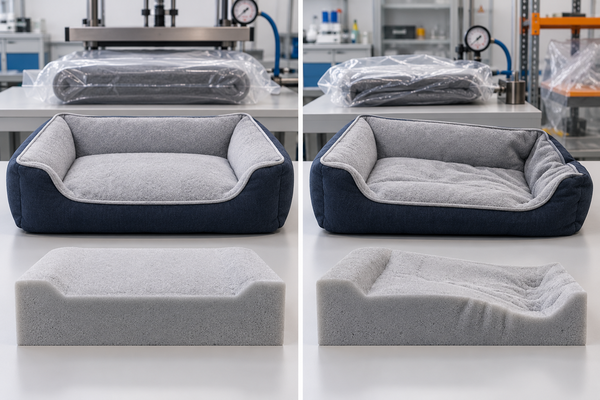
Before committing to vacuum compression, test for:
- Resilience of foam or filler materials after extended compression (e.g., maintaining 90% original fluffiness).
- Packaging seals that don’t puncture easily during transit.
- Market demand — whether compressed options sell better for mail-order models like Amazon.
Trade-offs like these must be addressed upfront at the design table rather than after production.
What Role Do Accessories Play in Packaging Size?
Accessories often take packaging by surprise — literally bulging out of retail boxes.
Poor accessory storage in packaging can damage aesthetics
Loose or irregularly packed accessories create bulges, increasing the risk of damage or box breakage.[^8] For instance, kennels with uncontained bolts or buckles might punch holes in cartons during shipping.
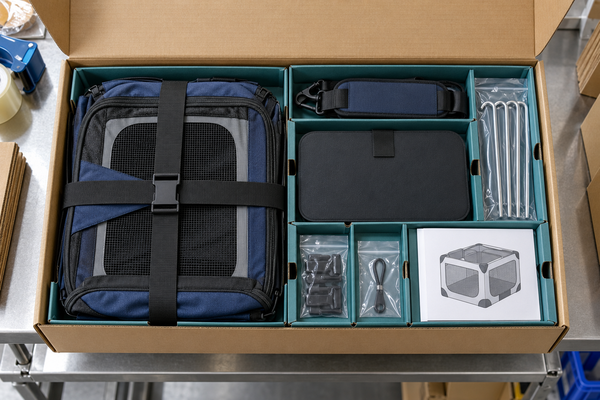
Opt for compartment separators or secondary inner pouches. This not only improves durability but also ensures the final product looks professional when unpacked. Work closely with your packaging team during structural prototyping to avoid surprises.
Retail vs. E-Commerce Packaging: What's the Difference?
Packaging isn’t one-size-fits-all, especially when shipping directly to customers versus stocking retail shelves.
Retail packaging prioritizes visual appeal, while e-commerce packaging focuses on transit protection
For example:
- Retail designs use colorful, windowed boxes meant to grab shopper attention.
- E-commerce cartons must have crush-resistant coatings, with internal spacers reducing damage risks in parcel journeys.
Optimizing for one scenario without the other can alienate an entire sales channel.
| Packaging Trait | Retail Packaging | E-commerce Packaging |
|---|---|---|
| Primary Goal | Shelf aesthetics | Protection from transit damage |
| Materials | Gloss-coated or printed designs | Minimalistic corrugated boxes |
| Consumer Focus | In-store emotional impulse | Accurate dimensions for fast returns processing |
Frequently Asked Questions
Can minimalist packaging improve profitability?
Yes, minimalist packaging uses fewer materials and reduces transit space but needs to preserve durability and usability — especially for e-commerce where rough handling occurs.
What should I test during packaging design?
Test folded dimensions, durability (drop tests), reassembly ease, long-term material resilience (foam bounce-back), and fit for various shipping configurations[^10] (palletized or individual parcel).
Should packaging focus more on logistics or consumer experience?
Both matter, but the focus depends on your primary sales channel. E-commerce prioritizes packing efficiency, while retail demands attention-grabbing designs.
Conclusion
The way you design and optimize packaging size can dramatically affect a pet product’s profit margin. By addressing factors like foldable frameworks, compression risks, accessory placement, and channel-specific requirements early, you’ll save on logistics costs and improve customer satisfaction. Sustainable packaging size doesn’t just compress costs — it compresses risk, too.[^11] Work with experienced OEM/ODM partners for thoughtful packaging from the start.[^12]
Looking to streamline your pet product packaging for better margins? Let’s talk!
[^1]: "The Impact of Visual Elements of Packaging Design on ... - PMC", https://pmc.ncbi.nlm.nih.gov/articles/PMC11851823/. Studies on packaging optimization have shown that reducing wasted space and improving structural design can lower logistics costs and enhance profitability, particularly in industries reliant on shipping efficiency. Evidence role: general_support; source type: research. Supports: Packaging size plays a critical role in determining profit margins by influencing logistics costs and customer satisfaction.. Scope note: The findings may not be specific to the pet product industry but are applicable to general retail and e-commerce sectors. [^2]: "How Packaging Affects Your Logistics Costs", https://sprintlogistics.com/reducing-your-packaging-can-reduce-your-logistics-costs/. Research on logistics efficiency highlights that oversized packaging can reduce container utilization by up to 30%, leading to higher transportation and storage costs. Evidence role: statistic; source type: research. Supports: Inefficient packaging design can lead to increased logistics costs by reducing the number of units that fit into standard shipping containers or storage spaces.. Scope note: The data may vary depending on the specific industry and product type. [^3]: "Optimizing distribution center packing operations to reduce ...", https://dspace.mit.edu/entities/publication/b2c6f71e-87f5-4cab-94d0-5e3034004095. Studies on modular packaging designs indicate that foldable or removable frameworks can decrease shipping volume by up to 40%, improving logistics efficiency. Evidence role: mechanism; source type: research. Supports: Removable frameworks allow for compact packaging, which can reduce shipping volume and costs.. Scope note: The effectiveness depends on the product type and consumer assembly requirements. [^4]: "The Impact of Visual Elements of Packaging Design on ... - PMC", https://pmc.ncbi.nlm.nih.gov/articles/PMC11851823/. Consumer behavior research suggests that overly compact packaging often results in negative user experiences, particularly when assembly instructions are unclear or components are difficult to handle. Evidence role: expert_consensus; source type: research. Supports: Compact packaging designs can lead to consumer frustration if reassembly is overly complex or unclear.. Scope note: The findings may vary depending on the product category and target audience. [^5]: "Manufacturer's Guide to", https://www.cpsc.gov/s3fs-public/pdfs/guide.pdf. Consumer studies suggest that detailed and easy-to-follow instructions enhance user experience, particularly for products requiring assembly or reconfiguration. Evidence role: expert_consensus; source type: research. Supports: Clear user instructions can significantly improve consumer satisfaction and reduce frustration with compact packaging.. Scope note: The effectiveness of instructions may depend on the complexity of the product and the target audience's familiarity with similar items. [^6]: "Recent Progress in Structural Integrity Evaluation of ... - PMC", https://pmc.ncbi.nlm.nih.gov/articles/PMC12737285/. Packaging engineering research highlights the importance of compression testing to evaluate the durability and resilience of materials under stress. Evidence role: mechanism; source type: research. Supports: Compression testing helps ensure that packaging can withstand external forces during transit without compromising product safety.. Scope note: The findings may not address specific types of packaging materials used in the pet product industry. [^7]: "The Influence of Storage Conditions on the Quality of Vacuum ...", https://pmc.ncbi.nlm.nih.gov/articles/PMC12564903/. Material science studies have shown that prolonged vacuum compression can reduce the resilience of foam materials, affecting their ability to regain original shape and elasticity. Evidence role: mechanism; source type: research. Supports: Vacuum compression can lead to material deformation and loss of elasticity, particularly in foam and soft fabrics.. Scope note: The degree of impact may vary based on the specific material composition and duration of compression. [^8]: "Why Packaging Durability is Important for Home ...", https://greatnorthernpackaging.com/2025/02/11/the-importance-of-packaging-durability-in-home-improvement-products/. Packaging studies indicate that loose accessories can puncture or deform cartons, increasing the likelihood of damage during shipping. Evidence role: mechanism; source type: research. Supports: Irregular accessory placement can compromise packaging integrity, leading to bulges and potential damage during transit.. Scope note: The findings are more applicable to products with heavy or sharp accessories. [^9]: "The Impact of Visual Elements of Packaging Design on ... - PMC", https://pmc.ncbi.nlm.nih.gov/articles/PMC11851823/. Industry reports highlight that retail packaging often incorporates visual elements to attract customers, while e-commerce packaging is designed to withstand shipping conditions and minimize costs. Evidence role: general_support; source type: research. Supports: Retail packaging emphasizes aesthetics for shelf appeal, whereas e-commerce packaging prioritizes durability and compactness for shipping.. Scope note: Specific requirements may vary depending on the product and target market. [^10]: "Performance Oriented Packaging Testing Policies & Procedures", https://www.phmsa.dot.gov/sites/phmsa.dot.gov/files/docs/LOGSA%20Policies%2C%20Procedures%20and%20Standards.pdf. Educational resources on packaging design emphasize the importance of comprehensive testing, including drop tests and material resilience evaluations, to ensure product safety and usability. Evidence role: mechanism; source type: education. Supports: Testing folded dimensions, durability, reassembly ease, and material resilience are critical steps in ensuring effective packaging design.. Scope note: Specific testing methods may vary depending on the product type and industry requirements. [^11]: "Sustainable Packaging | US EPA", https://www.epa.gov/smm/sustainable-packaging. Research on sustainable packaging practices indicates that optimizing size and materials can reduce logistics costs and minimize the risk of damage during transit. Evidence role: general_support; source type: research. Supports: Sustainable packaging size can lower costs and reduce risks such as product damage and environmental impact.. Scope note: The risk reduction aspect may depend on specific packaging designs and materials used. [^12]: "OEM vs ODM: Which Manufacturing Model is Right for Your ...", https://www.oteplace.com/blog-choosing-odm-vs-oem-in-manufacturing/. Industry guidelines suggest that collaboration with OEM/ODM partners can streamline the packaging design process and ensure alignment with production and logistics requirements. Evidence role: expert_consensus; source type: education. Supports: Experienced OEM/ODM partners can provide valuable expertise in designing efficient and effective packaging solutions.. Scope note: The effectiveness of such partnerships may depend on the specific expertise and resources of the OEM/ODM provider.



Questions or Comments?
Share your thoughts below. For OEM/ODM inquiries, contact our factory team directly by email or WhatsApp.