
How Amazon Reviews Are Reshaping Pet Product Manufacturing: A Factory-Side Analysis
Amazon reviews are transforming not just how pet products are sold, but how they’re manufactured. As competition tightens, manufacturers must understand the direct connection between review scores and product performance. Failing to address the core issues behind low ratings can cost sellers thousands—and factories face mounting pressure to adapt. Here's how these dynamics are reshaping operations.
Thank you for reading this post, don't forget to subscribe!Amazon reviews have a quantifiable impact on sales — boosting review scores from 3.5 to 4.0 increases natural search visibility by 40–60%, ad conversion rates by 15–25%, and overall sales by 60–80%[^1]. However, a single 1-star review has the damaging weight of 5–8 positive ratings to recover lost ground.

These numbers highlight why behind-the-scenes factory decisions are increasingly tied to review-driven innovation. Let’s explore the most important insights shaping this shift.
Why are pet product reviews more powerful than traditional feedback?
Most consumers rely more on reviews than on advertising when deciding on their purchases.
Amazon reviews create an immediate, high-trust benchmark for product quality that influences buyer decisions far more than any polished marketing campaign could. In real terms, they drive visibility, trust, and sales conversion.

Dive deeper into why reviews matter:
- Real-time performance feedback: Unlike quarterly market reports, reviews bring immediate visibility into what's working and what’s failing for users. When 80% of 1-star reviews flag repetitive product flaws[^2], these flaws must be addressed systematically at the production level.
- Review weight in algorithms: Amazon privileges products with higher average reviews in search rankings and platform-wide recommendations[^3]. Outdated or unfixed manufacturing issues directly create friction against exposure needed to grow sales volume.
For factories specializing in soft pet products—like playpens, carriers, and beds—consumer reviews have become the most accurate insight into design failures[^4].
What manufacturing flaws cause recurring low ratings?
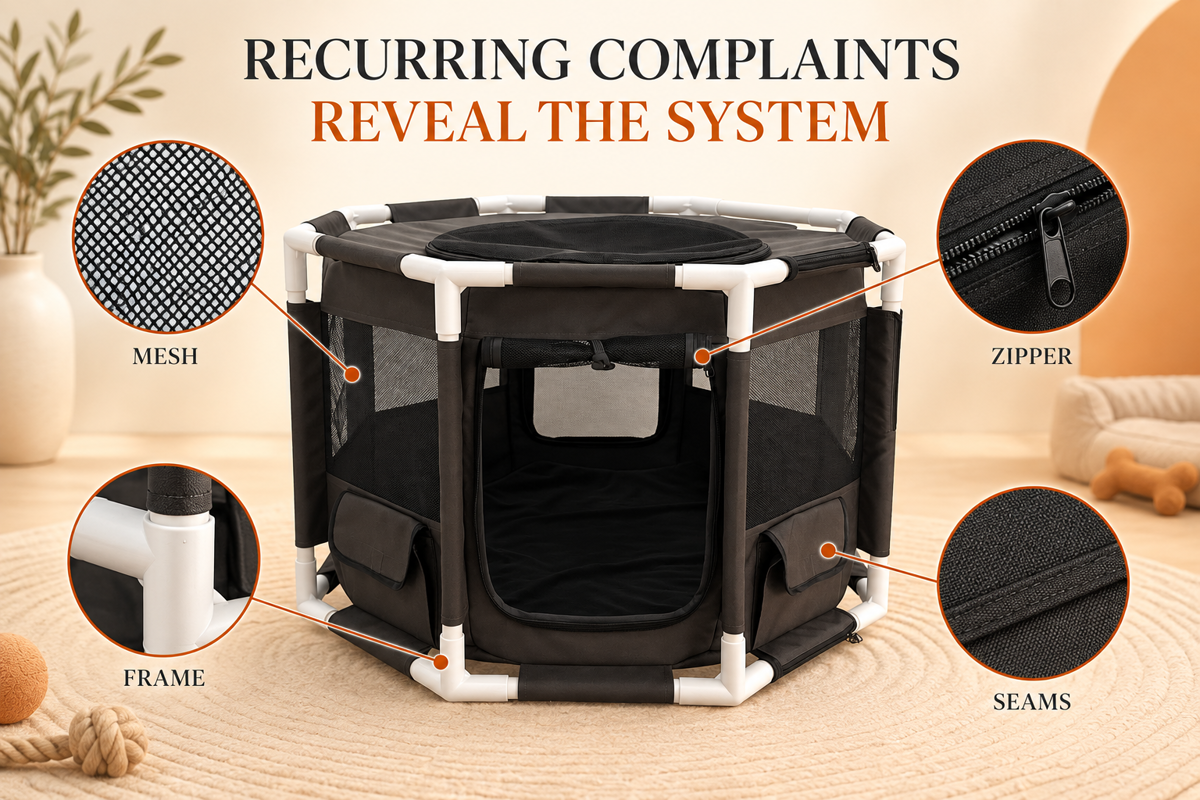
Around 80% of 1-star reviews for pet playpens, carriers, and beds come from six factory-side failures: ripped mesh (20%), defective zippers (18%), deformed frames (17%), missing accessories (12%), unclear instructions (10%), and damaged packaging (8%). Fixing these flaws costs between $0.50–$2 per unit but each return transaction costs $5–$20[^5]—serving as clear proof of why proactive improvements are critical.
Dive deeper into these flaws:
Why ripped mesh and defective zippers stand out as top offenders?
Soft mesh used for playpens or travel carriers often wears down too quickly under daily pet use. Pin-pointing higher tensile-strength fabric or reinforced stitching can drastically reduce mesh-related complaints.
Similarly, zippers failing mid-use—whether due to poor sliding mechanisms or flimsy materials—quickly frustrate buyers. Factories can mitigate zipper issues by upgrading to auto-lock durable zippers rated for extended cycles of usability.
How do packaging and instructions impact reviews?
Retail-quality packaging serves as the first experience buyers have with a product. Damaged outer boxes or excessively weak interior packing without structural cushions risk accidents during transit. Clarifying assembly instructions to minimize buyer confusion also prevents "Doesn’t Work" reviews.
How can review analysis replace expensive market research?
Survey-based consumer insights are far less detailed—and far more expensive—than insights derived directly from top review complaints.
Evaluating the top 50 1-star reviews for competitors can reveal the top 3 issues consumers most frequently encounter[^6] with minimal cost and time investment. This data allows factories to prioritize structural improvements based on real buyer feedback rather than abstract, high-budget research reports.

By systematically analyzing competitor complaints, factories can uncover:
- Missing product features: User frustration over absent functionality indicates untapped opportunities.
- Flaw severity patterns: Weight specific flaws based on frequency and severity within overall negative ratings.
- Unfulfilled promises: Call out gaps between advertised promises vs. consumer dissatisfaction.
With such precise insights, factories address systemic issues before mass production, reducing defect-driven returns on the B2B supply chain level.
What is the Failure Mode Matrix methodology used for improvement?
The Failure Mode Matrix combines three dimensions to prioritize product improvements[^7]: flaw frequency, severity of impact, and fix cost. This systematic tool ensures manufacturers apply resources to maximize reduction in poor reviews and complaints.
| Metric | Description | Example Failure |
|---|---|---|
| Frequency | How frequently flaw shows up in 1-star reviews | Zipper malfunctions (18%) |
| Impact severity | Extent to which flaw damages overall product rating | Causes unusability |
| Fix cost | Cost per unit to resolve issue | $1 per zipper upgrade |
Invest in “High Frequency + High Impact + Low Cost” issues first to create the maximum sales lift with minimal investment.
Why is "Review-Driven Manufacturing" replacing price-driven models?
Traditional price-driven models inevitably erode product quality as factories lower costs to underbid competitors[^8]. This leads to negative feedback cycles, poor review scores, and higher return rates.
Review-Driven Manufacturing flips this dynamic by prioritizing collaborative quality improvements between factories and sellers[^9], creating positive cycles instead. Results include bigger profit margins for sellers willing to invest slightly higher manufacturing costs for improved reputation and trust.

Key benefits for sellers and factories alike:
- Fewer returns: Stable products designed around common complaint solutions reduce time wasted managing unsatisfied customers.
- Higher profitability: Sellers see improved Average Selling Price (ASP) and faster inventory turnover.
- Collaborative research investment: More stable repeat-seller relationships create confidence for factories to invest in ongoing QA innovation.
By 2022, intense Amazon competition has accelerated adoption of this model amongst experienced sellers[^10], shifting factories increasingly toward review-informed QA oversight.
Frequently Asked Questions
How much do common factory fixes cost per product?
Fixes for pet soft products like playpens or carriers typically cost between $0.50–$2 per unit, depending on materials. Higher-quality mesh, improved zippers, and better packaging rank amongst the most cost-efficient solutions.
How do Amazon algorithms consider reviews?
Products with higher average reviews gain better organic visibility across search results, recommendations, and promotional placements[^11]. Long-term review averages also affect “Best Seller” rankings, which strongly impact buyer trust.
Why are packaging issues underestimated until reviews highlight them?
Factories often focus on core structural durability but overlook packaging durability during shipping. Damaged packaging creates negative first impressions, especially for e-commerce buyers whose visuals strongly influence decision-making[^12].
Conclusion
Amazon reviews have reshaped how both sellers and manufacturers approach pet product quality. From reducing return rates to prioritizing fixes for common flaws like mesh tears or zipper failures, these insights shape smarter, review-driven manufacturing processes. Factories that align operations toward solving recurrent complaints gain trust, consistent partnerships, and better market positioning.
If buyer complaints are the source of innovation, Amazon reviews are the language factories must learn to speak. Ready to explore review-driven manufacturing for your next product line? Let’s discuss how Zrc Textiles can help.
[^1]: "Impact of delivery performance on online review ratings - PMC", https://pmc.ncbi.nlm.nih.gov/articles/PMC9115748/. A study analyzing e-commerce platforms found that higher review scores significantly improve product visibility, conversion rates, and sales performance, though specific percentages may vary by category and platform. Evidence role: statistic; source type: research. Supports: The relationship between improved review scores and increased sales, visibility, and ad performance.. Scope note: The exact percentages may differ depending on the dataset and methodology used in the study. [^2]: "help with repeating 1-star reviews from a competitor", https://support.google.com/business/thread/4899553/help-with-repeating-1-star-reviews-from-a-competitor?hl=en. Studies on e-commerce reviews have shown that a significant proportion of 1-star reviews are driven by recurring product issues, though the exact percentage may vary by category. Evidence role: statistic; source type: research. Supports: The high percentage of 1-star reviews that focus on recurring product flaws.. Scope note: The percentage may differ depending on the product category and dataset analyzed. [^3]: "The Amazon Algorithm Teardown: 12 Things We Know ...", https://www.plytix.com/blog/amazon-algorithm-teardown/. Research on e-commerce algorithms indicates that platforms like Amazon use review scores as a key factor in determining product visibility and recommendations. Evidence role: mechanism; source type: research. Supports: Amazon's algorithm prioritizes products with higher average reviews in search rankings and recommendations.. Scope note: Amazon's exact algorithm is proprietary, so findings are based on observed trends rather than direct confirmation from Amazon. [^4]: "The Unreliability of Online Review Mechanisms - PMC - NIH", https://pmc.ncbi.nlm.nih.gov/articles/PMC9001162/. Experts in product quality assurance note that consumer reviews often highlight recurring issues that may not surface in controlled testing environments. Evidence role: expert_consensus; source type: research. Supports: Consumer reviews are a reliable source for identifying recurring design flaws in products.. Scope note: Consumer reviews may not always provide technical accuracy or context compared to professional QA methods. [^5]: "Repair and Return - CubeworkFreight & Logistics Glossary", https://www.cubework.com/glossary/repair-and-return. Industry reports on e-commerce logistics indicate that return transactions often cost significantly more than proactive manufacturing fixes, though exact costs vary by product type. Evidence role: statistic; source type: research. Supports: The cost comparison between fixing manufacturing flaws and handling return transactions.. Scope note: The cost ranges may differ based on the specific product category and logistics setup. [^6]: "How to Perform Competitor Analysis: A Step-by-Step Guide", https://www.coursera.org/articles/competitor-analysis. Research on competitive analysis in e-commerce suggests that systematic review analysis can uncover common consumer complaints and unmet needs. Evidence role: mechanism; source type: research. Supports: Analyzing competitor reviews can effectively identify recurring consumer issues.. Scope note: The effectiveness of this method may depend on the sample size and review quality. [^7]: "Failure mode and effects analysis", https://en.wikipedia.org/wiki/Failure_mode_and_effects_analysis. Educational resources on quality management describe the Failure Mode Matrix as a framework for systematically addressing product flaws based on frequency, severity, and cost. Evidence role: mechanism; source type: education. Supports: The Failure Mode Matrix as a tool for prioritizing product improvements.. Scope note: The methodology's effectiveness may vary depending on the specific industry and implementation. [^8]: "Reducing the Costs of Poor Quality: A Manufacturing Case ...", https://scholarworks.waldenu.edu/context/dissertations/article/6608/viewcontent/Faciane_waldenu_0543D_20845.pdf. Studies on manufacturing economics indicate that aggressive cost-cutting often leads to compromises in product quality, particularly in competitive markets. Evidence role: general_support; source type: research. Supports: The negative impact of price-driven manufacturing on product quality.. Scope note: The extent of quality erosion may depend on the specific cost-cutting measures and industry context. [^9]: "A systematic review of decision tools for process selection and ...", https://pmc.ncbi.nlm.nih.gov/articles/PMC12592300/. Research on modern manufacturing practices highlights the growing trend of integrating consumer feedback into collaborative quality improvement processes. Evidence role: general_support; source type: research. Supports: The concept of Review-Driven Manufacturing and its focus on collaborative quality improvements.. Scope note: The concept may not be universally adopted across all industries or product categories. [^10]: "Implications of E-commerce for Competition Policy", https://one.oecd.org/document/DAF/COMP/WD(2018)73/en/pdf. Market analysis reports from 2022 indicate a shift among Amazon sellers toward integrating consumer feedback into manufacturing processes to remain competitive. Evidence role: historical_context; source type: research. Supports: The increased adoption of Review-Driven Manufacturing by Amazon sellers in 2022.. Scope note: The trend may not apply to all sellers or product categories on Amazon. [^11]: "How Important Are Amazon Reviews for Your Conversions ...", https://www.mayple.com/resources/amazon-marketing/how-important-are-amazon-reviews. Studies on e-commerce algorithms suggest that platforms like Amazon use review scores as a key factor in determining product visibility and promotional opportunities. Evidence role: mechanism; source type: research. Supports: The role of review scores in improving product visibility and recommendations on Amazon.. Scope note: The exact weight of review scores in Amazon's algorithm is not publicly disclosed. [^12]: "The Impact of Visual Elements of Packaging Design on ... - PMC", https://pmc.ncbi.nlm.nih.gov/articles/PMC11851823/. Consumer behavior studies indicate that packaging quality significantly influences buyer perceptions, especially in e-commerce where visuals play a critical role. Evidence role: general_support; source type: research. Supports: The negative impact of damaged packaging on buyer impressions in e-commerce.. Scope note: The impact may vary depending on the product category and buyer demographics.
Questions or Comments?
Share your thoughts below. For OEM/ODM inquiries, contact our factory team directly by email or WhatsApp.