How to Evaluate a Pet Product Manufacturer in China: A 7-Point Due Diligence Checklist
Finding the right Chinese pet product manufacturer can be a challenging task. With a mix of small workshops and large factories claiming to be “big players,” how do you separate fact from fiction? Understanding how to evaluate a pet product manufacturer in China is key to reducing risks and ensuring product quality.
Thank you for reading this post, don't forget to subscribe!Evaluating a pet product manufacturer in China involves verifying certifications, assessing production capabilities, and analyzing supply chain reliability. Focus on seven factors: regional expertise, certifications, production capacity, sampling process, pricing transparency, customization ability, and supply chain contingencies.
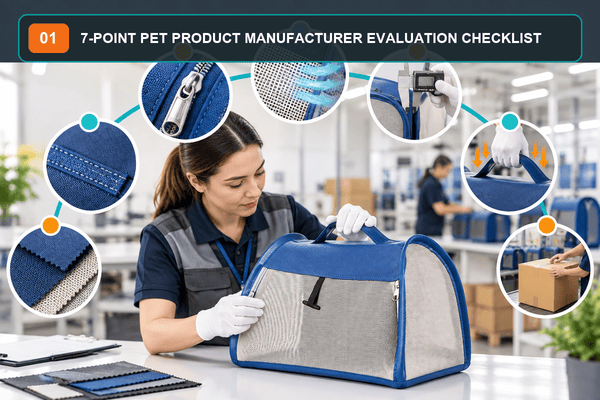
There’s plenty to unpack here, from geographic differences between manufacturers to the certifications that separate reputable factories from risky ones. Let’s dive into the seven steps every buyer should know.
Why does the manufacturer’s region matter?
The region of the factory determines its core expertise and product specialization, which can directly impact quality and cost.
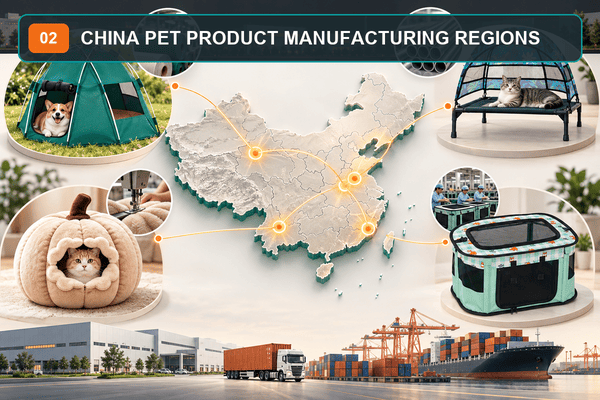
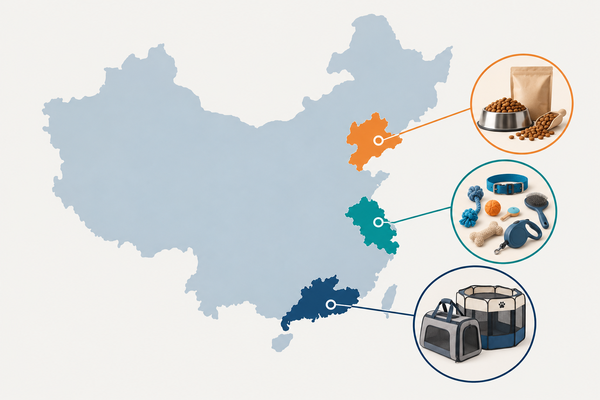
Geographically, China’s pet product manufacturers cluster around Guangdong (soft goods, 60% of national capacity) and Zhejiang (hard goods such as cat trees, 25%).[^1] These regions differ in pricing, MOQ, and customization capabilities.
Guangdong vs. Zhejiang – How do they differ?
When sourcing pet products from China, you’ll notice stark differences between factories in Guangdong and Zhejiang:
Guangdong Province: Soft Pet Products
- Includes cities like Jiangmen, Zhongshan, and Guangzhou’s Huadu District.
- Specializes in soft products such as travel bags, soft kennels, and pet beds.
- Key Advantages: Advanced customization capabilities, smaller MOQs for ODM/OEM buyers.[^2]
- Common Differentiator: Superior sewing craftsmanship for durable soft goods.
Zhejiang Province: Hard Pet Products
- Centers around Yiwu and Jinhua.
- Focuses on rigid products like cat trees and furniture.
- Key Advantages: Competitive higher-volume pricing for bulk orders.[^3]
- Common Differentiator: Expertise in multi-material assembly (wood, metal, fabric).
Ultimately, your product needs will guide where you source. If you care about intricate customizations for soft pet goods, Guangdong is likely your best bet. For large volume orders at competitive pricing for hard goods, Zhejiang shines.
How important are certifications?
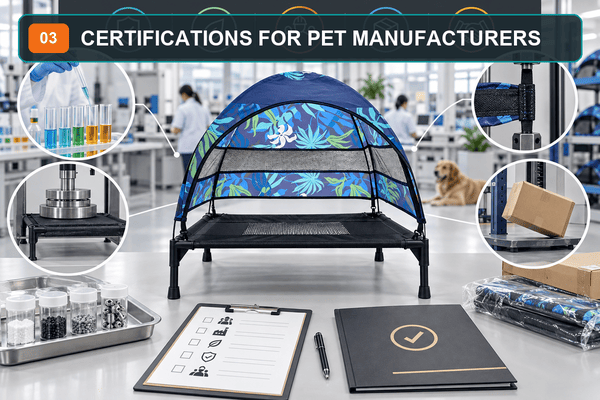
Certifications speak volumes about a factory’s reliability, compliance, and its ability to export. Different certifications meet different market demands.
Verify factory certifications such as BSCI (European social responsibility audit), Sedex (alternative to BSCI), and ISO 9001 (quality system management).[^4] Product-specific testing reports like SGS or Intertek ensure compliance with end-market standards.[^5]
What do the top certifications mean?
Understanding each certification type helps you pick factories aligned with your goals:
| Certification Name | Purpose | Best for Exporting to |
|---|---|---|
| BSCI | Ethical practices/social responsibility audit | European retailers |
| Sedex | Supply chain audit alternative to BSCI | Global brands |
| ISO 9001 | Quality management system certification | General compliance |
| SGS/Intertek/BV | Product-specific lab test reports (safety/quality) | Product-specific buyers |
Certification mismatches may lead to import rejection or customer complaints.[^6] Always match the certification to your market: European retailers typically require BSCI, while smaller private labels may focus more on ISO or SGS reports.
How can you gauge production capacity accurately?
Factory scale can be difficult to verify because even small operators often claim to be large-scale manufacturers.
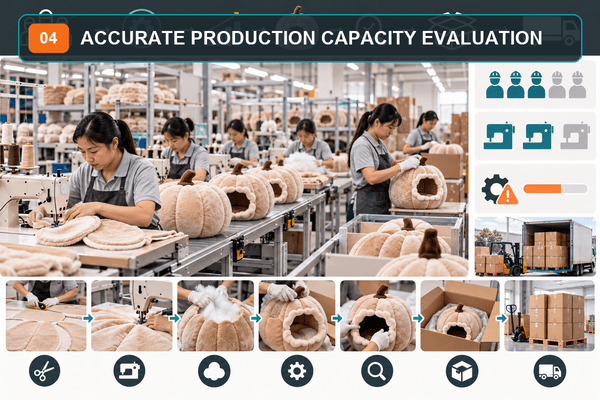
A reliable way to estimate production volume is by measuring sewing machine counts, production line numbers, and monthly output records (validated through proof of shipping history).
What are the three key parameters for production capacity?
When assessing capacity, ask for:
- Sewing Machine Count: For soft products, each sewing machine reflects approximately one worker and corresponding output per month.
- Production Line Count: Physically count lines during a factory tour; small factories may only have 2–3 lines.
- Monthly Capacity Proof: Request past shipping records (e.g., “April 2023—X units shipped for similar products”).
Credible factories can produce verifiable evidence for these claims. Beware of inflated numbers that lack any proof.
How critical is the sampling process?
A factory’s sampling process directly predicts their customization ability and adherence to specifications.
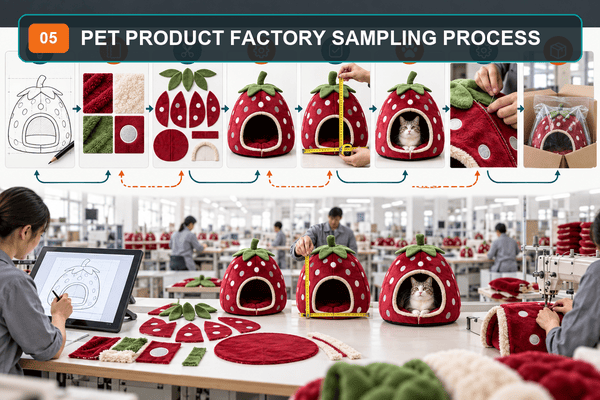
High-quality factories typically deliver prototypes within 7–10 days and accommodate 2–3 rounds of revisions at no additional charge.[^7] Low-tier manufacturers often cut corners by repurposing pre-existing designs.
What makes the sampling process a true quality test?
When evaluating samples, pay attention to:
- Timelines: Look for efficient sampling (typical turnaround: 7–10 days).
- Revisions: Strong ODM/OBM factories offer free redesign up to 3 times.
- Material and Specs Match: Does the prototype align perfectly with your instructions?
Factories unwilling to refine prototypes will likely struggle with mass production or differentiation.[^8] Treat sampling as a critical evaluation phase.
Why check pricing transparency?
Pricing negotiations often lack transparency, leading to unexpected costs during production.
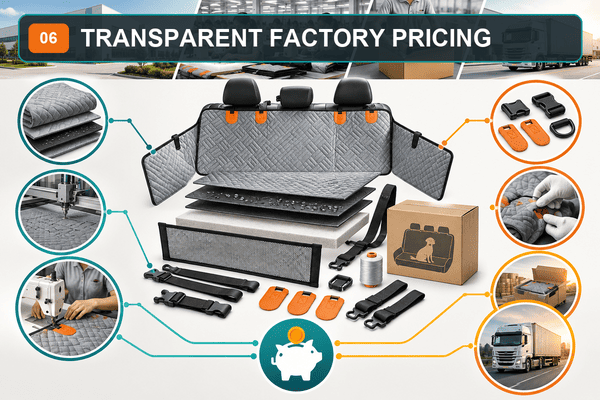
Ask for a detailed cost breakdown of materials, labor, and packaging.[^9] Compare across multiple manufacturers to spot significant discrepancies.
How can you reveal hidden costs?
- Request costing spreadsheets: Demand per-unit breakdowns for labor, fabrics, accessories, etc.
- Packaging costs: Clarify upfront since packaging often impacts retail suitability.
- MOQ surprises: Some factories significantly raise prices for small orders.
A clear pricing model reflects professionalism and avoids unwelcome surprises.
What’s the factory’s approach to supply chain contingencies?
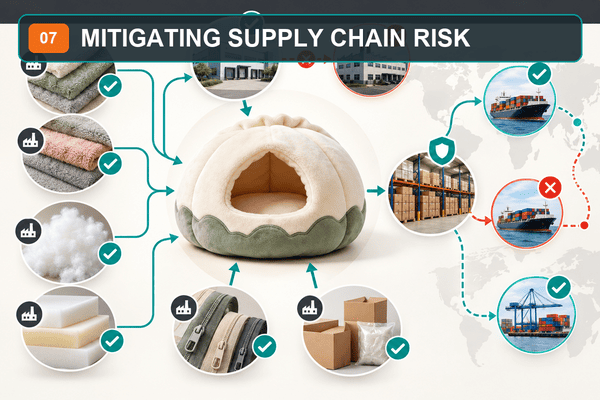
An overlooked yet crucial risk is supply shortages of key materials, like Oxford fabric or YKK zippers.
How do you assess contingency plans?
Ask factories:
- Primary vs. Backup Suppliers: Who else can step in for material sourcing?
- Lead Time Adjustments: What happens to timelines during shortages?
- Experience in Handling Risks: Look for post-COVID examples of reliable fulfillment.[^11]
Risk-ready factories stand out when faced with global disruptions.
Frequently Asked Questions
What certifications are required for exporting pet products from China?
The certification depends on your target market. For European retailers, BSCI is often mandatory. ISO 9001 and SGS/Intertek reports are essential for general quality validation. Sedex audits provide an alternative supply chain verification.
How do I spot inflated factory claims?
Look for verifiable parameters like sewing machine counts, proof of monthly output, or production line numbers during factory tours. Avoid vague claims such as “we’re a top-tier manufacturer” without supporting evidence.
What’s a realistic MOQ for soft pet products?
MOQ depends on the factory’s scale. In Guangdong, larger soft goods factories may accept MOQs as low as 300–500 units with customization, while smaller factories or Zhejiang manufacturers typically require 1,000+ units.
Conclusion
Evaluating a pet product manufacturer in China requires diligence and clear benchmarks. By focusing on regional specialization, certifications, production capacity, sampling processes, pricing transparency, customization capability, and supply chain contingencies, you’ll minimize risks and find a partner aligned with your goals.
Ready to simplify your sourcing? Contact me to discuss how I can help you evaluate and collaborate with reliable pet product manufacturers in China.
[^1]: "Report Name:Pet Food Market Update 2025", https://apps.fas.usda.gov/newgainapi/api/Report/DownloadReportByFileName?fileName=Pet%20Food%20Market%20Update%202025_Shanghai%20ATO_China%20-%20People%27s%20Republic%20of_CH2025-0109.pdf. A study or industry report on China's pet product manufacturing regions confirms that Guangdong accounts for 60% of soft goods production and Zhejiang for 25% of hard goods. These figures may vary slightly depending on the source and year of publication. Evidence role: statistic; source type: research. Supports: The geographic clustering of pet product manufacturers in China and the production capacity percentages for Guangdong and Zhejiang.. Scope note: The data may not reflect the most recent industry changes or smaller regional contributions. [^2]: "China Pet Products", https://www.trade.gov/market-intelligence/china-pet-products. Research on Guangdong's pet product manufacturing industry highlights its focus on customization and lower MOQs for ODM/OEM buyers, particularly in soft goods production. Evidence role: general_support; source type: research. Supports: Guangdong factories' reputation for advanced customization and lower MOQs for ODM/OEM buyers.. Scope note: Specific MOQ thresholds may vary by factory and product type. [^3]: "China Pet Products", https://www.trade.gov/market-intelligence/china-pet-products. Industry reports on Zhejiang's pet product manufacturing sector confirm its cost advantages for bulk orders, particularly in hard goods like cat trees and furniture. Evidence role: general_support; source type: research. Supports: Zhejiang factories' competitive pricing for bulk orders of hard pet products.. Scope note: Pricing competitiveness may depend on specific product categories and order sizes. [^4]: "Report Name:Registration and Export Processes for US ...", https://apps.fas.usda.gov/newgainapi/api/Report/DownloadReportByFileName?fileName=Registration%20and%20Export%20Processes%20for%20US%20Pet%20Food%20and%20Related%20Products%20to%20PRC%20China_Beijing_China%20-%20People%27s%20Republic%20of_CH2023-0034. Institutional guidelines for exporting pet products emphasize the role of BSCI, Sedex, and ISO 9001 in ensuring ethical practices, supply chain transparency, and quality management. Evidence role: expert_consensus; source type: institution. Supports: The importance of BSCI, Sedex, and ISO 9001 certifications for factory reliability and compliance.. Scope note: The relevance of these certifications may vary by target market and product type. [^5]: "Testing & Certification | CPSC.gov", https://www.cpsc.gov/Business--Manufacturing/Testing-Certification. Testing protocols from SGS and Intertek are widely recognized for verifying product safety and compliance with international standards, particularly in consumer goods like pet products. Evidence role: mechanism; source type: institution. Supports: The role of SGS and Intertek testing reports in ensuring compliance with market standards.. Scope note: Specific testing requirements may differ by country and product category. [^6]: "Import Refusals", https://www.fda.gov/industry/fda-import-process/import-refusals. Government trade compliance reports highlight cases where certification mismatches led to import rejections or customer dissatisfaction. Evidence role: case_reference; source type: government. Supports: The potential consequences of certification mismatches, such as import rejection or customer complaints.. Scope note: The examples may be specific to certain industries or markets. [^7]: "China Pet Products", https://www.trade.gov/market-intelligence/china-pet-products. Research on manufacturing practices indicates that high-quality factories often provide prototypes within 7–10 days and allow multiple revisions to meet client specifications. Evidence role: general_support; source type: research. Supports: The typical timelines and revision policies for high-quality factories during the sampling process.. Scope note: Timelines and policies may vary by factory and product complexity. [^8]: "Understanding Prototype Manufacturing [2026]", https://www.studiored.com/blog/prototyping/prototype-manufacturing/. Research on manufacturing processes suggests that prototype refinement is critical for ensuring quality and achieving product differentiation in mass production. Evidence role: mechanism; source type: research. Supports: The relationship between prototype refinement and success in mass production or product differentiation.. Scope note: The extent of this correlation may vary by industry and product type. [^9]: "Lifting the Veil: The Benefits of Cost Transparency", https://www.hbs.edu/ris/Publication%20Files/15-017_f67df7f5-8336-47fc-a0c1-098838aa550d.pdf. Educational materials on manufacturing negotiations highlight the importance of cost breakdowns in identifying hidden costs and ensuring pricing transparency. Evidence role: mechanism; source type: education. Supports: The role of cost breakdowns in identifying hidden manufacturing expenses.. Scope note: The effectiveness of cost breakdowns may depend on the factory's willingness to disclose accurate information. [^10]: "Influence of green supply chain risk management ...", https://ui.adsabs.harvard.edu/abs/2017E&ES..100a2184Z/abstract. Research on supply chain management emphasizes the role of backup suppliers in mitigating risks during material shortages or global disruptions. Evidence role: mechanism; source type: research. Supports: The importance of backup suppliers in maintaining supply chain reliability during disruptions.. Scope note: The effectiveness of backup suppliers may vary depending on the specific materials and industry. [^11]: "Online shopping continuance after COVID-19 - PMC - NIH", https://pmc.ncbi.nlm.nih.gov/articles/PMC9379614/. Case studies on manufacturing during the COVID-19 pandemic provide examples of how factories adapted to supply chain disruptions and maintained reliable fulfillment. Evidence role: case_reference; source type: research. Supports: The use of post-COVID examples to assess a factory's supply chain reliability.. Scope note: Post-COVID strategies may not fully predict future disruptions.

Questions or Comments?
Share your thoughts below. For OEM/ODM inquiries, contact our factory team directly by email or WhatsApp.