How to Choose a Pet Product Manufacturer in China: 15 Questions for OEM/ODM Buyers
Finding a reliable pet product manufacturer in China sounds straightforward — until your first shipment lands with torn mesh, bent frames, and a return rate that kills your margin[^1]. Vetting manufacturers before you commit is not optional. It is the decision that separates brands that scale from brands that stall.
Thank you for reading this post, don't forget to subscribe!Choosing a pet product manufacturer in China requires buyers to go beyond catalog size and price quotes. The right supplier should demonstrate direct control over every process relevant to their product category — fabric cutting, stitching, frame assembly, zipper sourcing, in-line inspection, and defect handling. Verifying this process evidence protects buyers from hidden failure points that only appear after products reach end consumers.

Most buyers start with the wrong filters. They sort by MOQ, price, and star ratings on sourcing platforms. Those signals matter, but they do not tell you whether a factory can actually build your specific product to a consistent standard. The 15 questions below give you a structured framework for evaluating any potential supplier before you place a development sample — let alone a production order.
Does the Factory's Core Capability Match Your Product Category?
Many buyers assume a large catalog means broad manufacturing capability. In practice, a wide catalog often signals trading company behavior or heavy subcontracting — neither of which gives you the process control you need[^2].
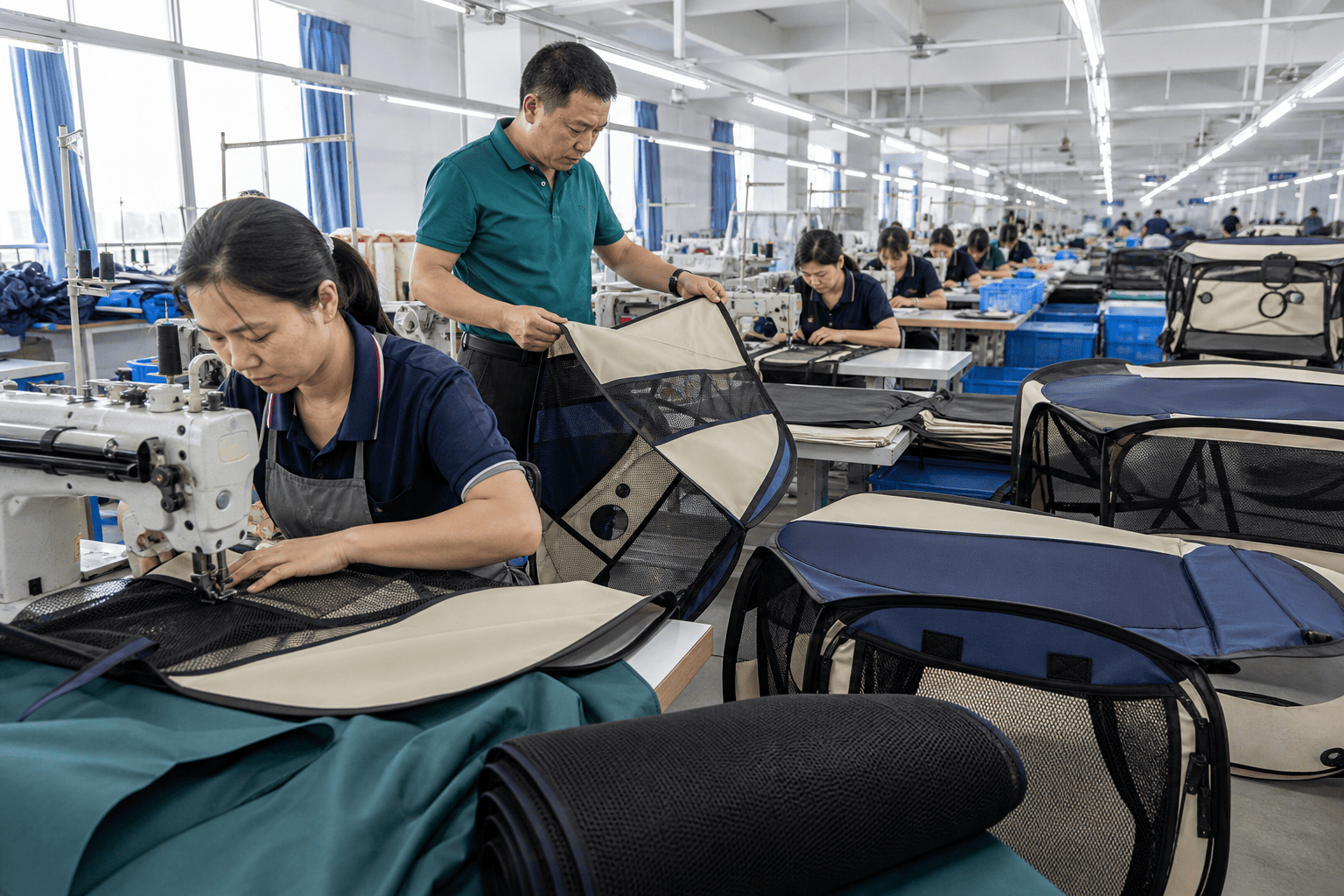
The right question is not "what products do you make?" but "what processes do you run in-house?" For sewn, framed pet products — playpens, crates, carriers, soft kennels — you need a factory that directly controls fabric cutting, stitching, mesh assembly, zipper integration, frame bending or welding, and final packaging. Each gap in that chain is a potential failure point.
Why Sewn and Framed Pet Products Are Structurally Complex
Pet playpens, foldable crates, and soft carriers are not simple textile items. They combine at least five material categories in a single SKU:
- Woven or Oxford fabric (structural panels and floor)
- Mesh panels (ventilation, visibility — often the first failure point)
- Zippers (primary access, must handle repeated stress)
- Metal or PVC tube frames (shape, load-bearing, fold mechanism)
- Stitching and webbing straps (connection points between all of the above)
Weak coordination between these five elements creates hidden failure points. The mesh may be correctly sourced but poorly attached at the seam. The frame tubes may be adequate gauge but the joint caps may crack under lateral load. The zipper may pass individual tensile tests but bind after 50 cycles because of misaligned fabric tension.
I have seen buyers receive samples that look excellent in photos and feel solid on first inspection — only to discover that the frame corner joints fail within a few weeks of consumer use. The root cause is almost always a coordination gap between departments or between the factory and an external subcontractor.
When evaluating a supplier, ask them to walk you through every process step for your specific product category. If they hesitate or speak only in general terms, that is a signal worth investigating further.
Capability Red Flags to Watch For
| Signal | What It May Indicate |
|---|---|
| Very wide catalog across unrelated categories | Trading company or heavy subcontracting |
| Cannot name their frame supplier | Outsourced without quality oversight |
| Mesh attachment done "by another workshop" | Limited control over a common failure point |
| No dedicated QC station on the sewing line | Defects caught only at final inspection |
| Sample quality varies across identical units | Inconsistent operator training or process |
Can the Supplier Provide Documented Process Evidence?
Verbal reassurance from a sales team is not process evidence. Buyers evaluating a pet product manufacturer in China should request documentation that confirms real operational capability — not just marketing claims.
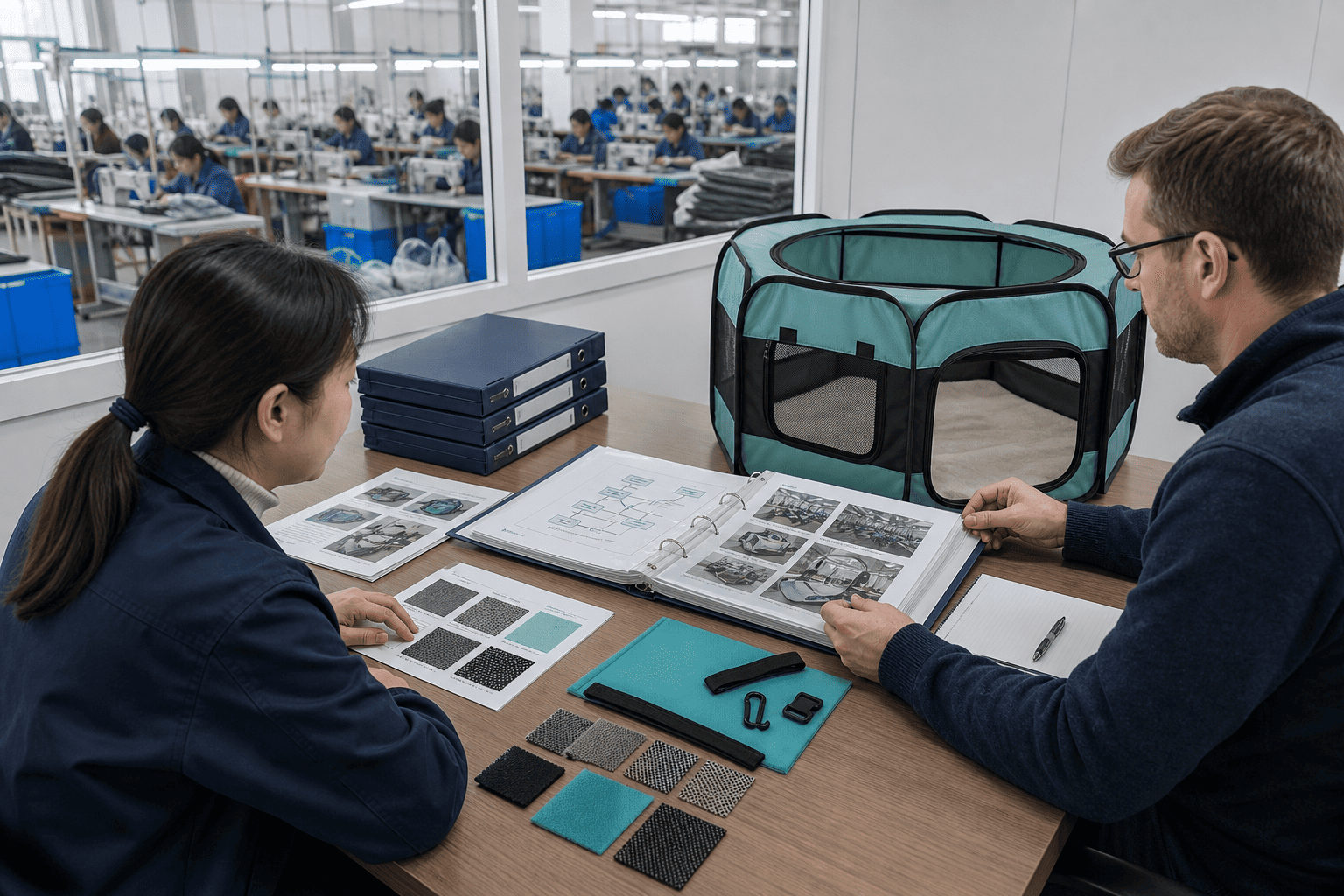
Process evidence includes physical factory audit records, in-line inspection checklists, equipment lists with quantities, and third-party test reports for the specific materials or finished products in your category. This documentation tells you whether quality control is systematic or incidental.
What to Request Before Signing Any Agreement
Here is a practical checklist of documents worth requesting during supplier evaluation:
- Factory registration and operating license — confirms legal entity and establishment date
- BSCI audit report or equivalent social compliance certificate[^3] — indicates third-party verification of labor and management practices
- Equipment list — number and type of sewing machines, cutting tables, welding or bending equipment
- In-line QC checklist — the actual form used by floor inspectors during production
- Finished product test reports — material safety, zipper endurance, fabric tensile strength, mesh pull force
- Defect log or CAR (corrective action report)[^4] — evidence that the factory tracks and resolves production problems systematically
Not every factory will have every document on day one of contact. But a capable manufacturer should be able to produce most of these within a reasonable timeframe. Reluctance to share documentation is itself informative.
Operating History as a Proxy for Process Maturity
A factory's founding year matters more than buyers often assume[^5]. A manufacturer that has operated for over a decade has, by necessity, resolved most of the early-stage process failures — material sourcing inconsistency, operator training gaps, frame dimension drift — that plague newer operations.
"We have been manufacturing textile pet products since 2011. That operating history means our sewing procedures, material standards, and inspection routines have been tested and corrected across thousands of real production runs — not just in development samples." — Zrc Textile factory context
This does not mean age equals quality. It means that a verifiable operating history, combined with documentation, gives buyers a more complete picture than catalog photos alone.
How Many Questions Should You Ask Before Committing to a Sample?
Many buyers rush to the sample stage before they have enough information to evaluate what they receive. A sample from an unqualified supplier gives you limited useful data — you cannot tell whether it represents the factory's typical output or an exceptional effort made only for evaluation.
You should ask at least 15 structured questions before committing to a development sample. These questions should cover: manufacturing scope, in-house processes, equipment capacity, QC methodology, material sourcing, compliance documentation, customization capability, defect handling, lead times, and communication structure.
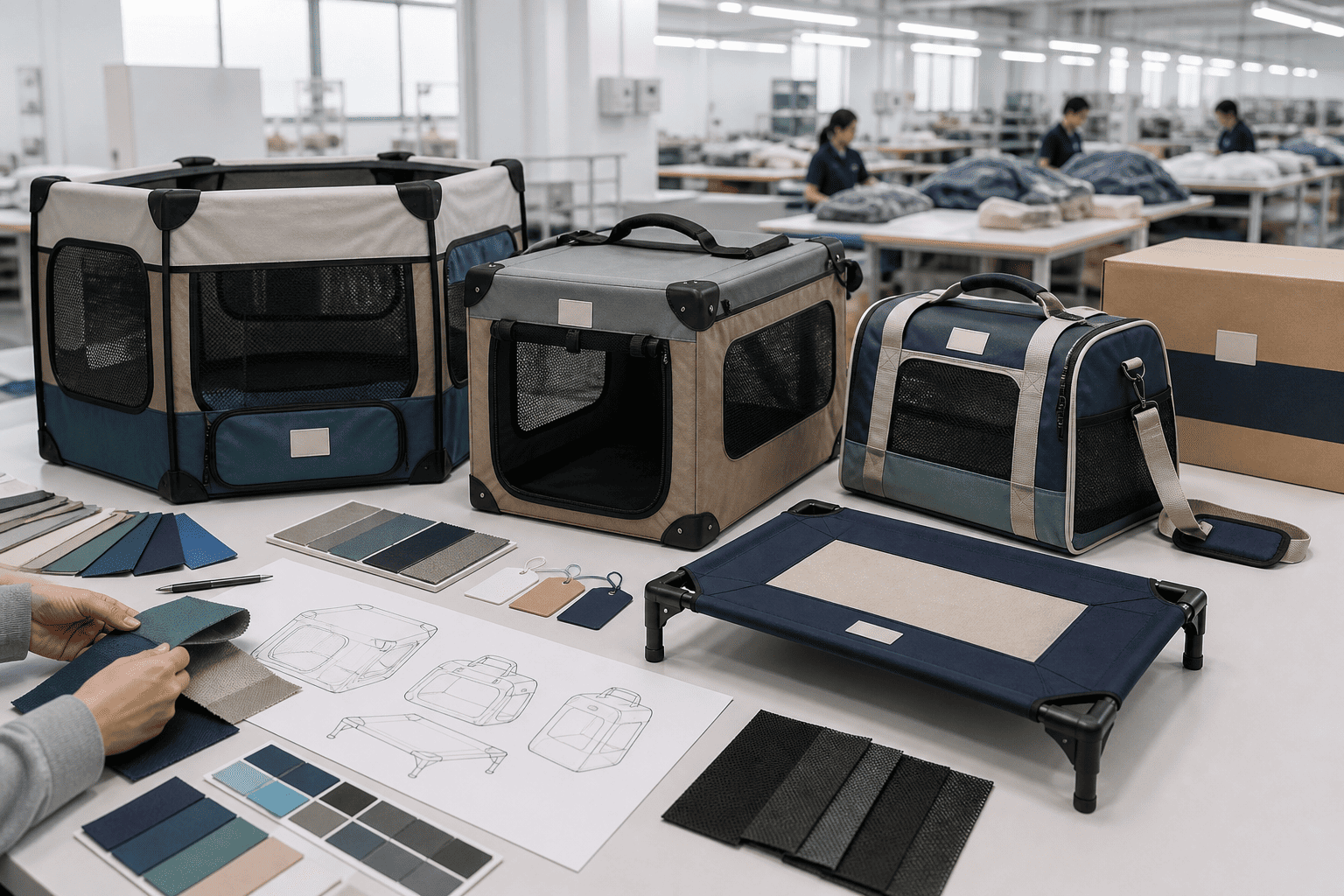
The 15 Questions Framework
Here are the 15 questions I recommend every OEM/ODM buyer ask before placing a sample order with a China pet product manufacturer:
Manufacturing Scope and Capability
- What product categories do you manufacture in-house, versus sourcing finished or semi-finished from other factories?
- What specific processes do you run on-site for sewn and framed products?
- How many sewing machines do you operate, and how many production lines run simultaneously?
Material Sourcing and Coordination
- Who supplies your mesh, fabric, zippers, and frame components? Do you have long-term supplier relationships or do you source spot?
- Do you conduct incoming material inspection? What does that process look like?
- Can you accommodate buyer-specified materials or components?
Quality Control and Defect Handling
- Where in the production process do you conduct in-line quality checks?
- What is your documented defect rate for your main product categories?
- How do you handle defects identified after packing — or after shipment?
- Can you share a recent corrective action report or defect log?
Customization and OEM/ODM
- What customization scope do you support — dimensions, materials, colors, hardware, packaging?
- Have you developed private label products for retail or e-commerce buyers before? Can you share non-confidential references?
- What is your typical sample development timeline for a modified or new design?
Compliance and Communication
- What social compliance or product safety certifications do you hold? Can you share current reports?
- Who manages buyer communication during production — a dedicated account contact or a rotating sales team?
Why Each Question Category Matters
| Category | What It Reveals |
|---|---|
| Manufacturing scope | Whether production is genuinely in-house |
| Material sourcing | Supplier's control over the most common failure points |
| QC and defect handling | Whether quality is managed or just hoped for |
| OEM/ODM capability | Whether customization is real or just relabeling |
| Compliance and communication | Long-term partnership viability |
These questions are not designed to intimidate a supplier. A capable manufacturer will welcome them. They distinguish serious buyers from price-only inquiries — and that distinction matters to both sides.
What Makes a Reliable OEM/ODM Partner for Private Label Pet Products?
Private label buyers have requirements beyond basic manufacturing. They need a supplier who can translate a market problem — negative reviews, structural failures, packaging complaints — into a product improvement that hits retail and e-commerce requirements.
A reliable OEM/ODM partner for private label pet products demonstrates: consistent quality across production runs (not just samples), flexible customization depth, retail-ready packaging capability, and a systematic approach to resolving the specific failure points common in their product category — torn mesh, broken frames, weak stitching, and unclear instructions.
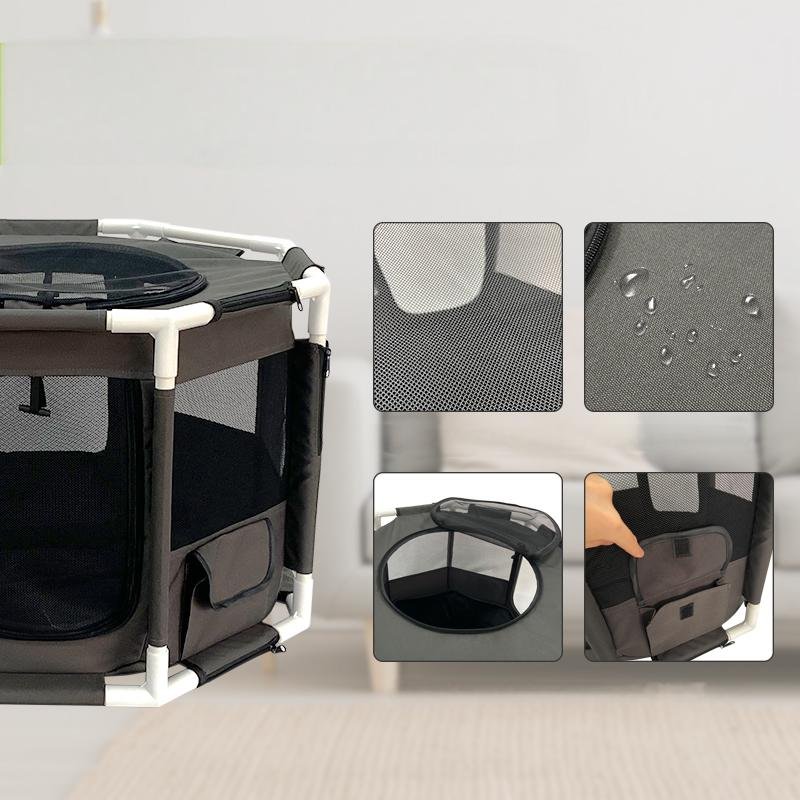
The Review-Driven Manufacturing Approach
One framework I find genuinely useful when evaluating suppliers is asking how they use end-market feedback. Specifically: do they track the negative reviews and return reasons that affect your product category, and do they translate that data into production decisions?
This is worth asking directly: "Can you show me a product improvement you made based on customer complaint data?"
A supplier who can answer that question with a specific example — changed mesh attachment method after seam-separation complaints[^6], reinforced frame joint caps after corner-failure returns, redesigned zipper pull after breakage reviews — is demonstrating a quality culture that protects your brand.
Common failure points in fabric and frame pet products include:
- Mesh panel separation at the sewn perimeter — often caused by insufficient seam allowance or wrong stitch type[^7]
- Frame corner joint cracking — caused by undersized cap dimensions or brittle plastic grade
- Zipper failure after repeated cycling — often a slider quality issue, not the tape itself
- Stitching thread breakage at stress points — carrier handle attachments, playpen door hinges
- Packaging damage in transit — affects e-commerce returns even when the product itself is undamaged
A factory that can articulate how they address each of these is a factory worth developing with.
Frequently Asked Questions
How do I verify a Chinese pet product manufacturer's claims without visiting the factory?
Request third-party audit reports (BSCI, SEDEX[^8], or equivalent), current product test certificates, and an equipment list. Video factory tours add useful context but do not replace documentation[^9]. If possible, engage a third-party inspection agency for pre-shipment or during-production checks before your first full order.
What is the difference between OEM and ODM when sourcing pet products in China?
OEM (Original Equipment Manufacturing) means the factory produces to your design specifications. ODM (Original Design Manufacturing) means the factory offers existing designs that you can modify and brand as your own. Most buyers use a hybrid: start with an ODM base design, then apply OEM customization for dimensions, materials, and packaging.
What certifications should a China pet product manufacturer hold?
For most export markets, buyers should look for: BSCI or SEDEX for social compliance, and product-level test reports covering material safety (e.g., EN 71 or ASTM F963 for relevant components[^10]), zipper endurance, and fabric tensile strength. Specific market requirements vary — always verify current requirements with a qualified compliance consultant for your target market.
Is a low MOQ always a good sign when evaluating a supplier?
Not necessarily. Very low MOQs can indicate a factory that relies on off-the-shelf components with minimal customization capability, or a trading company rather than a direct manufacturer. Ask what the MOQ covers — is it for a standard existing item, or does it apply to a customized OEM development? The answers are usually very different.
How important is communication structure when choosing a manufacturer?
Very important, especially for OEM/ODM development. If your product questions are answered by a rotating sales team without technical knowledge, development errors accumulate. Ask whether you will have a dedicated account contact who can speak directly to production and QC teams. Consistent communication reduces sample revision cycles and production surprises.
Conclusion
Choosing the right pet product manufacturer in China is a structured evaluation process, not a catalog comparison. The 15 questions in this framework cover the areas that matter most: in-house process control, material coordination, QC methodology, customization depth, and compliance documentation. Large catalogs do not prove capability. Process evidence does.
For sewn and framed pet products — playpens, crates, carriers, soft kennels — the gap between a supplier who looks right and a supplier who performs consistently often comes down to how well they coordinate fabric, mesh, zippers, frames, and stitching across a single SKU. That coordination only comes from direct process ownership.
If you are evaluating suppliers for a pet product development project, we welcome the hard questions. Contact Zrc Textile to request our factory profile, available compliance documentation, and product test reports for your relevant category.
[^1]: "What Drives Pet Food Choices? A Systematic Literature Review", https://pmc.ncbi.nlm.nih.gov/articles/PMC12649392/. Consumer complaint databases and product safety reports document structural failures in pet containment products, including mesh separation and frame integrity issues, as recurring quality concerns. Evidence role: general_support; source type: research. Supports: common failure modes in consumer pet products. Scope note: Quantitative return rate data for specific product categories may not be publicly available. [^2]: "Customer integration in the supply chain: the role of market ...", https://pmc.ncbi.nlm.nih.gov/articles/PMC9936943/. Research in operations management indicates that vertical integration and direct process control are associated with reduced quality variation in multi-component manufactured products, though the magnitude of the effect varies by industry and product complexity. Evidence role: general_support; source type: research. Supports: the relationship between manufacturing process control and product quality consistency. Scope note: Studies may not specifically address the pet product manufacturing sector or Chinese manufacturing contexts. [^3]: "Key Topic: What Is Social Auditing?", https://www.dol.gov/agencies/ilab/sourcingstrong/steps-to-a-social-compliance-system/step-5-monitor-compliance/key-topic-what-is-social-auditing. The Business Social Compliance Initiative (BSCI) is a supply chain management system developed by the Foreign Trade Association (FTA) that supports companies in monitoring and improving working conditions in their supply chains through a standardized audit framework. Evidence role: definition; source type: institution. Supports: the nature and purpose of BSCI certification. [^4]: "Corrective Action Report: Comprehensive Guide & Best ...", https://www.6sigma.us/six-sigma-in-focus/corrective-action-report/. ISO 9001 and related quality management standards require organizations to document nonconformities and implement corrective actions, with the corrective action report (CAR) serving as a standard tool for recording problems, root cause analysis, and resolution tracking. Evidence role: definition; source type: institution. Supports: the role of corrective action reports in quality management systems. [^5]: "A roadmap for managing an ageing workforce in the ... - PMC", https://pmc.ncbi.nlm.nih.gov/articles/PMC12444273/. Organizational learning research demonstrates that manufacturing experience contributes to process refinement and quality improvement over time, though the rate of improvement varies based on knowledge management practices and competitive pressures. Evidence role: general_support; source type: research. Supports: the relationship between organizational tenure and operational capability. Scope note: This relationship is not deterministic; organizational age does not guarantee superior performance without accompanying process investment. [^6]: "Effect of Different Sewing Parameters on Lockstitch Seam Strength for ...", https://www.academia.edu/67471432/Effect_of_Different_Sewing_Parameters_on_Lockstitch_Seam_Strength_for_Denim_Fabric. Textile engineering research identifies seam construction parameters—including stitch type, seam allowance, thread selection, and stitches per inch—as critical determinants of seam strength and resistance to separation under stress. Evidence role: mechanism; source type: education. Supports: how seam construction methods influence textile product durability. [^7]: "(PDF) Seam Performance of Garments", https://www.academia.edu/76397522/Seam_Performance_of_Garments. Textile engineering standards document that seam allowance width and stitch classification (lockstitch, chain stitch, overlock, etc.) directly affect seam strength, with inadequate allowance or mismatched stitch type for the application being common causes of seam failure under stress. Evidence role: mechanism; source type: education. Supports: technical factors influencing seam integrity in textile products. [^8]: "Empowering companies to take action on sustainability - Sedex", https://www.sedex.com/about/. SEDEX (Supplier Ethical Data Exchange) is a membership organization that provides a platform for companies to manage and share ethical supply chain data, including labor standards, health and safety, and environmental practices, through standardized audit formats. Evidence role: definition; source type: institution. Supports: the nature and purpose of SEDEX. [^9]: "8 Supplier Management Best Practices and Strategies", https://www.apexanalytix.com/resources/blog/supplier-management-best-practices/. Supply chain management frameworks recommend multi-method supplier verification, with third-party documentation and on-site audits considered more robust than visual inspections or vendor-provided materials alone. Evidence role: expert_consensus; source type: institution. Supports: standard practices for supplier verification in procurement. Scope note: Specific verification requirements vary by industry, regulatory context, and risk tolerance. [^10]: "ASTM F963 Requirements", https://www.cpsc.gov/Business--Manufacturing/Business-Education/Toy-Safety/ASTM-F-963-Chart. EN 71 is a European standard for toy safety, and ASTM F963 is a U.S. toy safety standard; these are referenced in pet product contexts when components (such as fasteners or materials) share characteristics with toy components. Evidence role: definition; source type: government. Supports: the scope of EN 71 and ASTM F963 standards. Scope note: These standards are designed for toys rather than pet products specifically, and their application to pet products is context-dependent rather than regulatory.


Questions or Comments?
Share your thoughts below. For OEM/ODM inquiries, contact our factory team directly by email or WhatsApp.